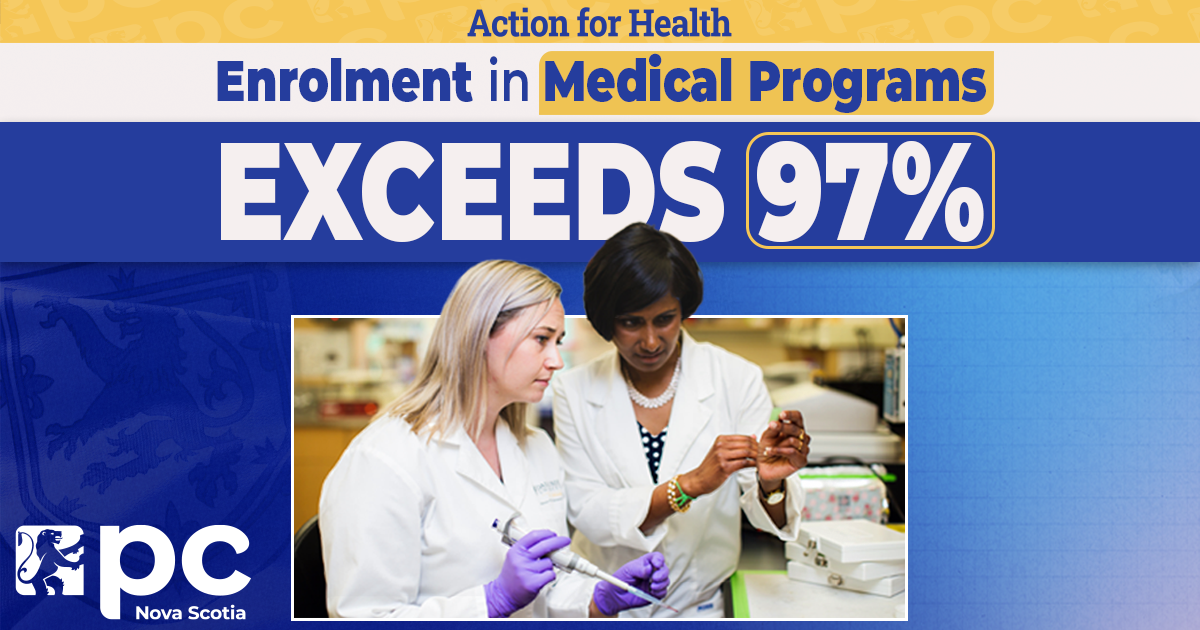
Our PC government’s plan to grow the healthcare workforce is gaining momentum, with universities across the province surpassing their enrolment targets for healthcare programs this fall. Most institutions have exceeded the 97 per cent target laid out in their funding agreements with the Province—an important milestone in training more healthcare professionals at home.
This year’s target called for nearly 1,800 first-year students across 35 programs at six universities. Instead, enrolment has climbed to about 1,900 as programs expanded to meet rising demand.
“Our PC government is ensuring that more healthcare workers are being trained in Nova Scotia,” said Brendan Maguire, Minister of Advanced Education. “By exceeding their healthcare seat targets, universities are training our future healthcare workforce right here at home. When students can access these programs in their communities, they’re more likely to stay, work and build their careers in Nova Scotia.”
Under the 2025–27 bilateral agreements, a portion of a university’s operating grant is held back until it confirms 97 per cent of healthcare seats are filled. This year, programs at Acadia, Cape Breton, Dalhousie, St. Francis Xavier and Mount Saint Vincent universities are operating above their original capacity. Université Sainte-Anne is working with the Province to increase enrolment in its small French-first social work program, which currently has eight of 10 seats filled.
Our government continues to invest heavily in healthcare education. More than $44.5 million was invested in healthcare training initiatives in 2024–25, alongside $58.9 million for the new Cape Breton medical campus that opened this fall. Targeted incentives—including free tuition, relief programs, bursaries and debt assistance—are also helping more Nova Scotians pursue careers in healthcare.
These results show a system pulling in the right direction: more opportunities for students, more training capacity across institutions and a stronger healthcare workforce for years to come that will deliver more care, faster.